

Inside this post I share 6 tips to help you write successful lesson plans for toddlers. I also share some info about my weekly Backyard Playlab class for toddlers and preschoolers.

- What is Backyard Playlab?
- What do kids learn at Backyard Playlab?
- What does the Backyard Playlab daily routine look like?
- How do I write lesson plans for toddlers?
- Blank Toddler Lesson Plan Templates
- Weekly Toddler Lesson Plans
- Week 1
- Week 2
- Week 3
- Week 4
- Week 5
- How to set up your own Backyard Playlab
- Get Weekly Playlab Plans
- Questions about starting your own Playlab
What is Backyard Playlab?
Backyard Playlab is a weekly class I teach for toddlers and preschoolers that is held in my backyard during the school year. Kids that participate are ages 2-5 and are dropped off for the two hour class.
Learn how to set up your own Backyard Playlab (or indoor playlab) and earn money while you're creating and playing with kids! Watch our Webinar NOW.

What do kids learn at Backyard Playlab?
Backyard playlab is a hands-on play based class for kids focused on simple science, art, and fine motor activities. The class is multi-aged and helps children build relationships, practice problem-solving, develop creativity, build motor skills, and increase their independent skills.
Kids learn the following skills at Backyard Playlab:
- language skills
- motor skills (fine and gross motor)
- social skills
- early learning skills
- self-regulation skills
Our curriculum is child focused, so we also embed additional skills that specific children might need to focus on.

RELATED: Learn how to set up your own Backyard Playlab (or indoor playlab) and earn money while you're creating and playing with kids! Watch our Webinar NOW.
What does the Backyard Playlab daily routine look like?
- Arrival
- Free choice (Available: fine and gross motor activities, sensory play, art activities, toy play)
- Snack/story time (I read aloud while the kids eat their snack)
- Group activities (games, movement activities, science projects, art activities)
- Closing activity (sensory or movement activity and goodbye song)
- Goodbye (Grown ups pick up the kids)

How do I write lesson plans for toddlers?
I use super simple lesson plans as I prepare for my Backyard Playlab each week. Lesson plans provide structure to what you're teaching toddlers and can help you make sure to focus on the most important things.
Here are 6 tips to help you write successful lesson plans for toddlers.
1. Get to know your students!
Getting to know your students is probably the most important part of lesson planning for toddlers. Once you know about their interests and skills, you can structure lessons to help them develop their skills in areas that they need to work on. Knowing their interests will also help you design activities that will be engaging and fun for them.
2. Define your goals.
Knowing what skills you want to focus on and what goals you want to accomplish during each week and throughout the year with each child will help drive your lesson plans.
Here are 6 skills that I think are most important for toddlers to develop.
3. Keep it simple.
Keep activities simple and routines structured but flexible. Toddlers thrive with consistent routines that also allow for flexibility.
4. Embed choice and open-ended activities into your plan.
Offering choices is great because it lets kids develop decision making skills. This boosts their confidence and self-esteem.
Open ended activities promote creativity! They also let kids develop new vocabulary, experiment, problems-solve and more,
5. Use themes!
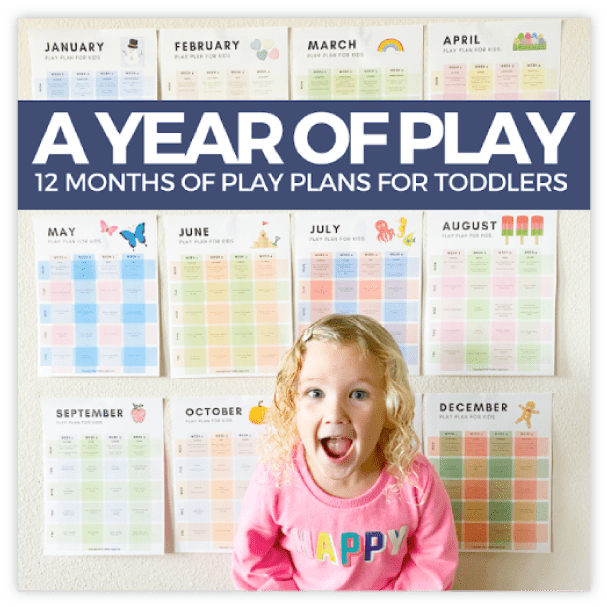
I love a good themed lesson. My Year of Play Toddler Curriculum is a great guide if you want a theme based plan right now. Themes provide a clear structure and focus for lesson plans, making it easier for toddlers to stay engaged and understand the content. Themes also help them make connections, build on prior knowledge, and more! Themes also make lesson planning so much simpler.
Sometimes themes can also be taken too far! It's ok if not every aspect of your lesson plan connects to the theme of the day. This helps ensure that all kids will connect with your lessons- especially any kids that might not like every theme you pick.

6. Make sure to embed play!
Toddlers need to play and move! Play is where toddlers can learn so many important skills. Sometimes we want to rush to make toddlers "big kids" and give them a structured school experience with lots of circle time and group learning time. I don't believe that a lot of time sitting down listening to the teacher is developmentally appropriate for toddlers.
Structure your play stations and free choice activities to help kids learn as they play! If you do plan for group circle time, incorporate hands-on and sensory experiences like singing songs with movement, using props or instruments, or exploring sensory bins.

Blank Toddler Lesson Plan Templates
Need some help to structure your lesson plans for toddlers? I'll share mine with you!
The most important part of any lesson plan for toddlers is to figure out what works for you! After years of teaching and exploring different types of lesson plans, I formatted a Backyard Playlab lesson plan that works for me.
You can use the Canva template below and personalize and edit my plan to make it work for your class. Make it useful for you and your situation with your own kids or students.

Download the Blank Lesson Plan Template using the button below.
Access the editable Canva Template using the button below.
Toddler Approved is a participant in the Amazon Services LLC Associates Program, an affiliate advertising program. As an Amazon Associate, I earn from qualifying purchases. Read more about these links in my disclosure policy.
Weekly Toddler Lesson Plans
Here are some example toddler lesson plans from my Backyard Playlab class.
Week 1:
Goals:
- Get comfortable at playlab/saying goodbye to grown up
- Learn the names of classmates
- Learn class routines/rules for activities, snack, group time
- Explore materials and how to use them
Some of the Week 1 Activities:


- Rock Pit Play
- Find my Friends Scavenger Hunt

- Animal Yoga with You Are a Lion by Taeeun Yoo


Week 2:
Goals:
- Learn the names of classmates
- Learn class routines/rules for going to the bathroom, group activities, and snack
- Explore sensory bin materials and learn how to use them
- Build fine motor skills using golf tees & mallets and turkey basters
Some of the Week 2 activities:
- PVC Pipe Water Play with Pom Poms


- Painting with water

- Shape invitation to create

- Kinetic sand sensory bin with CAT trucks & noodles

- Chalk + cardboard boxes


Week 3:
Goals:
- Do fine motor assessments (cutting with scissors, ripping paper, gluing, following 1-3 step directions, doing multiple steps).
- Introduce Fall themes- Apples & Leaves with Fall books and one simple activity.
- Practice listening and following directions through music time and bean bag play.
- Explore a new art technique (Hot glue resist art with watercolors)
Some of the Week 3 Activities:

- Spray bottles & chalk play on cardboard

- Cardboard box "playground" play

- Hot glue Leaf Resist Art

- Bean bag play (We use these bean bags)


Week 4:
Goals:
- Build fine motor skills while drawing lines.
- Assess current skills with drawing different types of lines (straight, curvy zip zag, circles, diagonal).
Some of the Week 4 activities:
- Fall Tree with dot markers

- Making and copying lines

- Q-Tip Painting Prints


- Making lines on leaves


Week 5:
Goals:
- Build fine motor skills using Q-tips, tongs, scoops, and more!
Some of the Week 5 activities:
- Trash truck themed sensory bin

- Snack time reading Garbage Crew to the Rescue! Thank you Chronicle Kids, Sherry Duskey Rinker, and AG Ford for sending up this fun NEW book to read together! The kids loved it.


- Painting Trash Cans

- Trash Toss Game

- Painting the recycling

- Doing Q-tip lines with water on chalk

- Making Pumpkin muffins! We used this recipe but put them in muffin tins.


How to set up your own Backyard Playlab
Setting up your own Backyard Playlab is actually fairly simple!
1. Decide you want to get started!
2. Pick a day and time for a weekly class that works for you (that would also work for toddlers and preschoolers).
3. Decide how many students you want to have. I typically stick to the childcare ratios for daycare permits (about 6 kids to 1 adult).
4. Decide on the age range for your students. My class is ages 2-5.
5. Look up any licensing requirements for your State/location to see if you'll need to get a daycare license. If so, do any training/certification needed.
6. Decide on how much tuition you plan to charge. Check out what other local toddler classes charge to get a gauge on what to ask people to pay.
6. Make a flyer and start advertising to your friends and neighbors! Use email and social media.
7. Once you have interested students, set up Get to Know You visits with each child and parent to make sure that the child and family will be a fit for your program.
8. Set up your outdoor (or indoor) classroom and get ready for your first day!
9. Pick a date to start your class!
10. Get started!
Get Weekly Playlab Plans
Are you interested in getting my Weekly Playlab Plans? Send an email to kristina@toddlerapproved.com.
Questions about starting your own Playlab
Do you have more questions about the process of setting up your own Backyard Playlab? Watch our Webinar!




Leave a Comment